

Dry Box
A calcium chloride desiccant developed specifically for shipping containers in export, import and coastal operations. It absorbs moisture from the air and locks it as a gel inside the sachet, keeping the container dry throughout the transit time.
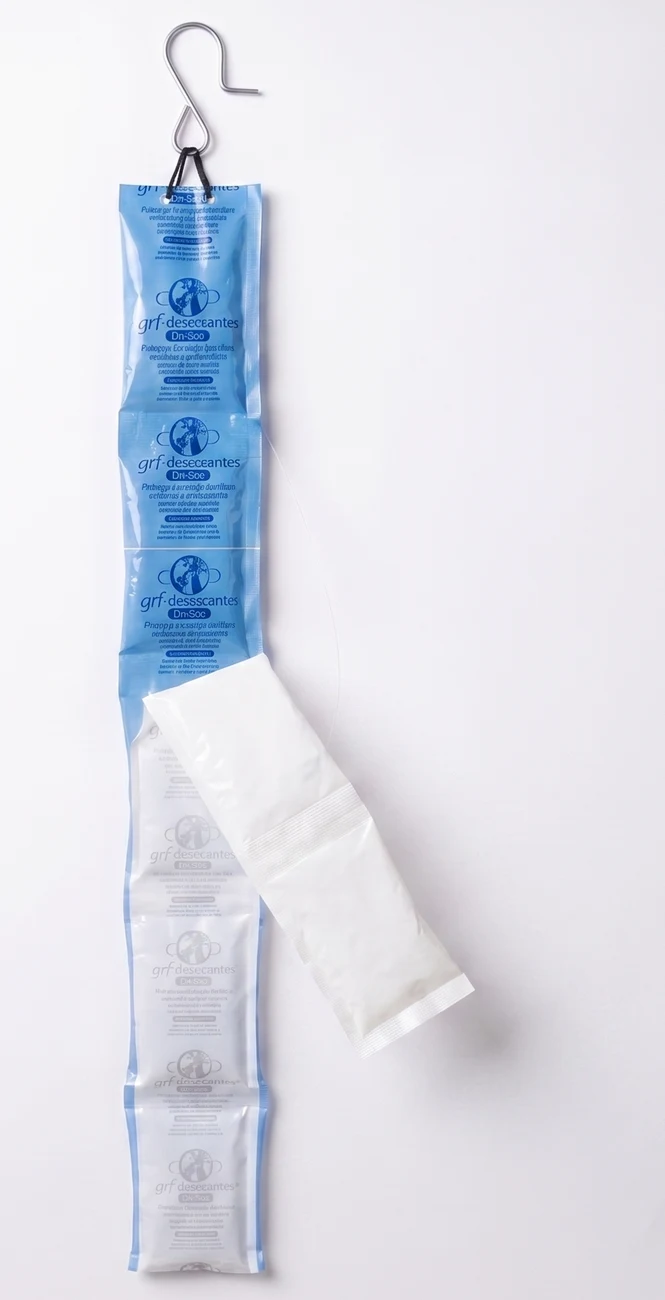
Available with hook or self-adhesive backing, in strips of 3 or 6 sachets, for fast application on container walls.
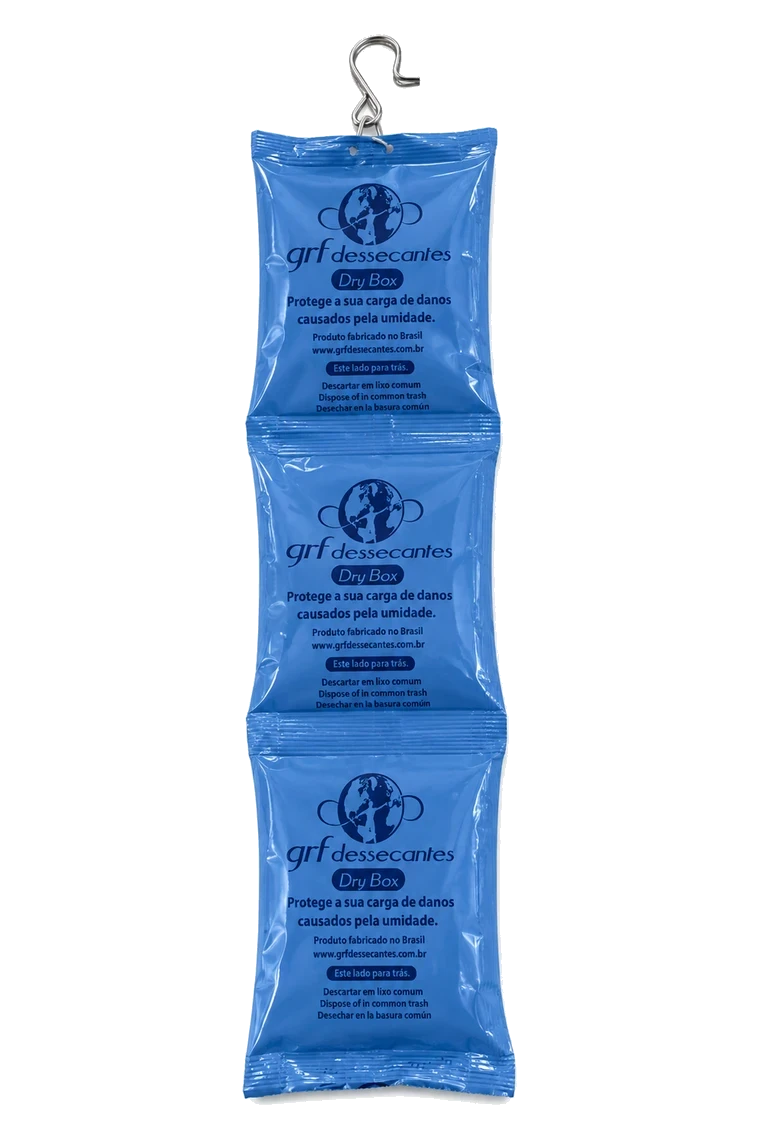
Watch in 1 minute
How Dry Box protects your container
From “container rain” to dry cargo on arrival: how moisture builds up inside the container, the damage it causes and how Dry Box prevents it. (Narration in Portuguese.)
How it works
Absorption by deliquescence, retention as gel
Dry Box works by deliquescence: calcium chloride captures water vapor from the atmosphere and dissolves in the absorbed water itself, forming an aqueous solution. The gelling agent retains this solution inside the sachet, immobilized as a gel — so the moisture is not released back into the container atmosphere.
This mechanism differs from adsorption desiccants (such as silica gel), which have a finite number of adsorption sites and therefore an intrinsic maximum capacity. Thanks to its formulation, Dry Box absorbs ambient moisture up to 3 times faster than competing desiccants.
The result: less condensation on container walls and ceiling (so-called “container rain”), less mold, corrosion and deformed packaging on arrival.
Data sheet
Product specifications
| Composition | Calcium chloride (CaCl₂) with gelling agent |
|---|---|
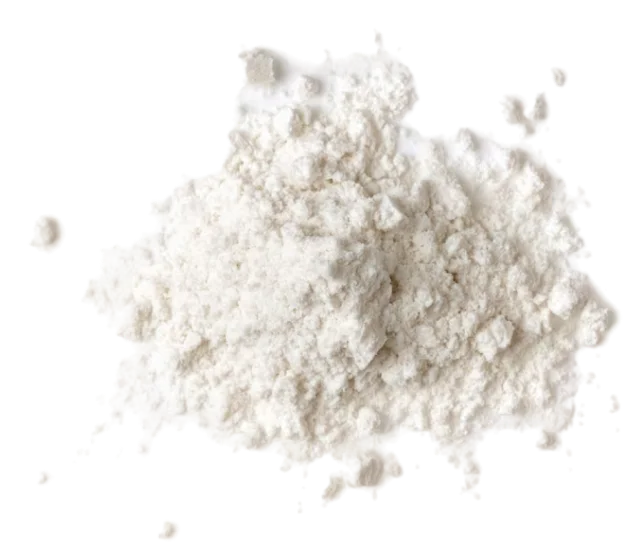
| Physical form | Granules, 1.0 to 4.0 mm |
| Bulk density | 0.18 g/mL |
| General characteristics | Odorless, inert, non-toxic |
| Residual moisture (140 °C) | Maximum 3% |
| Reference test condition | 45 °C and 90–95% relative humidity |
Source: Technical Data Sheet FT-DRYBOX-125, rev. 03 (August 2026). Request the full document through our contact channels.
Supply
Available configurations
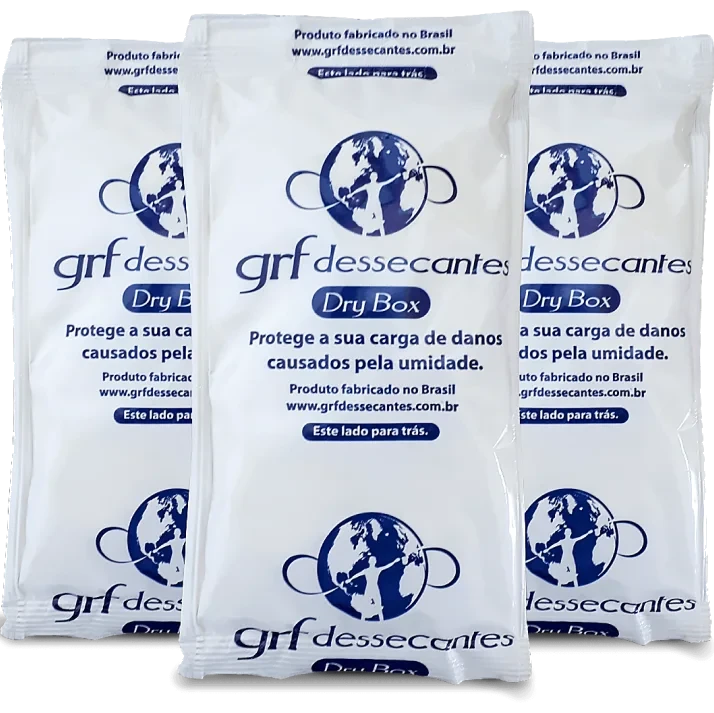
| Sachet | 125 g, non-woven wrapper with polymer layer |
|---|---|
| Strips | Strip of 3 sachets (375 g) and strip of 6 sachets (750 g) |
| Custom | Other numbers of sachets per strip are produced to the customer’s requirement |
| Box | 72 sachets — 9 kg net |
| Mounting | With hook, to hang on the wall, or self-adhesive, to fix directly onto the surface |
| Versions | Non-woven sachet and double-enclosure version (Double Shield) |
Strip, mounting and box configuration are adapted to each customer’s needs. Contact GRF to define the format for your operation.
Advantages
Why use Dry Box
Use
Applied on the walls of export and coastal shipping containers.
Duration
Keeps the container dry over long transit times.
Practical
Quick and easy to handle, apply and dispose of.
Made in Brazil
Manufactured in Brazil by a 100% Brazilian industry — fast delivery, no import costs.
Eco-friendly
All raw materials are environmentally friendly.
Non-toxic
Can be disposed of as regular waste — no hazardous residue.
Best practices
Correct use, inspection and replacement
Each sachet has a defined absorption capacity: once reached, it stops removing moisture from the environment and should be replaced. In long-term storage, periodic inspection and scheduled replacement are part of correct product use.
The retained solution is saline; do not place sachets directly on sensitive metal surfaces or on electrical/electronic equipment.
Correct sizing depends on the air volume, the tightness of the enclosure, the expected dwell time and the opening regime. GRF provides specific sizing guidance for your operation.
FAQ
Frequently asked questions about Dry Box
How much desiccant should I use per container?
It depends on the container air volume, tightness, transit time and door-opening regime. Tell us your route, transit time and cargo type and the GRF team will calculate the ideal amount of Dry Box for your operation, free of charge.
What is the difference between calcium chloride desiccant and silica gel?
Silica gel works by adsorption: it has a finite number of adsorption sites and therefore a capacity limited by the material itself. Calcium chloride captures moisture by deliquescence and retains it as a gel, absorbing ambient moisture faster and in larger amounts — which is why it is the standard for shipping containers.
How do I know when to replace the sachets?
The sachet should be replaced once it reaches the absorption capacity planned for the operation. In practice this is defined at the sizing stage: tell us the route, transit time and cargo type and GRF will indicate the quantity and the replacement interval. For long-term storage, carry out periodic inspection and scheduled replacement.
Is Dry Box toxic? How do I dispose of it?
Dry Box is non-toxic and can be disposed of as regular waste — it generates no hazardous residue. Keep out of reach of children and animals.
In which formats is Dry Box sold?
125 g sachets in strips of 3 (375 g) or 6 (750 g), with hook or self-adhesive, in boxes of 72 sachets. There is also a double-enclosure version (Double Shield). Other numbers of sachets per strip are produced to order.